
Sorry, not sorry
Why I'm not choosing a word of the year, but rewilding one instead

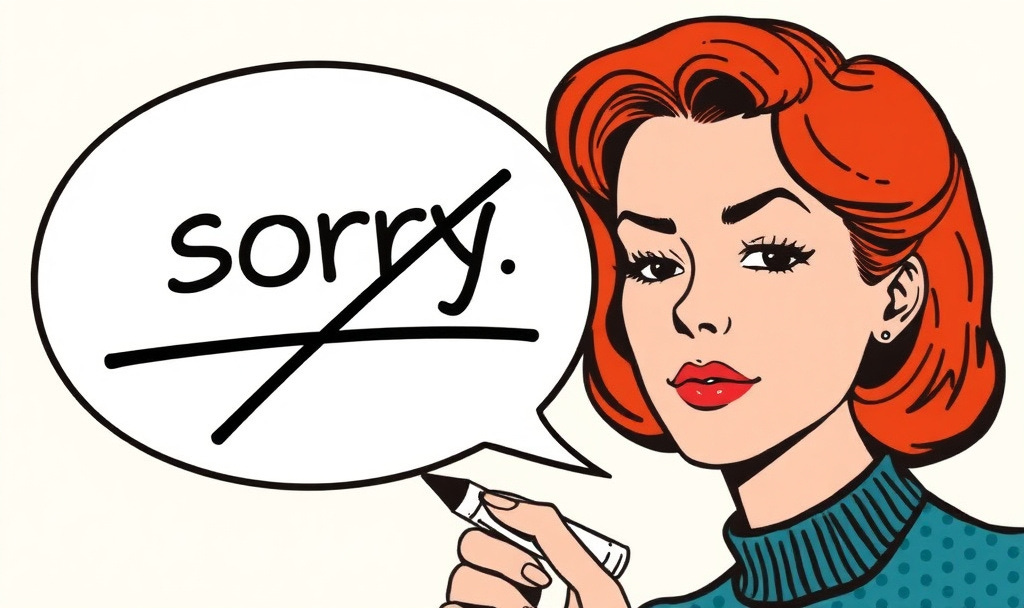
When other writers I follow take a break from their newsletters, they often return with an I’m sorry. It feels more like a required password to re-enter the conversation than real remorse.
So as I prepared to bring back The Sunday Stretch, I started to think about sorry itself. The word has become the duct tape of human interaction—a quick, drab-gray fix we slap on every interpersonal crack. And I realized that, like duct tape, it works best when no one looks too closely.
We now say sorry when we mean excuse me, thank you, get out of my way, please stop talking, I’m confused, I disagree but don’t want to fight, this meeting should’ve been an email, I feel weird existing in public, and I just inhaled a croissant and made eye contact with your dog. It does many things, none of them well.
Sorry used to have heft. It comes from an Old English word meaning “distressed, full of sorrow, or in pain.” Its root relates to sore. Like a bruise. Or a wound. To say sorry was to say, I caused you pain and I carry that weight.
Now? Every email starts with sorry for the delay as if we’re supposed to be always on, customer service reps for our own lives. We use it to deflect. I’m sorry you feel that way (translation: “that sounds like a you problem”). We use it as social lubricant. Sorry, can I squeeze past you? Sorry, I breathed in your vicinity. Sorry, the laws of physics allowed our atoms to collide.
When one word does everything, it eventually means nothing. If we use sorry for being late and for your grandma dying and for taking the last slice and for asking someone to pass the salt, how is anyone supposed to know when we’re actually acknowledging harm, that we’ve caused a wound and feel its weight?
Language, explains Don Miguel Ruiz in The Four Agreements, is a creative force. Words aren’t just sounds. They’re tools that shape our inner world, our identity, and our relationships. They are the blueprint of our reality. So if the blueprint is sloppy, held together with duct tape, then everything technically works, but doesn’t feel right. Nothing is broken enough to fix or solid enough to trust.
This year, I’m not choosing a word of the year. I’m choosing to restore one, to rewild sorry, and be impeccable with at least this one word.
Impeccability isn’t about perfection; it’s about alignment. It’s about pausing long enough to figure out what I actually feel, what I’m trying to express, and then let the words match. So instead of sorry for your loss, I can say I’m here. I see your grief. Instead of sorry to bother you, I might ask if you have a moment (because if I’m bothering you, an apology won’t fix that anyway.) Instead of sorry, can I squeeze past you?, I might try the radical excuse me.
If words are spells, as Ruiz says, influencing how we see ourselves and each other, then it’s no surprise that gender, race, culture, class, and context shape who is expected to apologize, how often, and for what. Women, in particular, are socialized to apologize more as a way to monitor our impact, manage everyone’s comfort, maintain harmony, prevent offense, and generally function as human emotional bubble wrap. Apologizing becomes a performance of softness, a protective strategy, a preemptive defense against being called angry, difficult, or a lot.
But when we default to sorry, we conjure a subtle force that whispers, “my presence is negotiable, my needs are secondary, and my boundaries are flexible.” I don’t want to cushion my own presence, pay the sorry tax just to access space, or shrink so others won’t have to adjust their expectations. I’d rather take up the average amount of human space and let sorry be what it once was—a word for sore places, for wounds, for tenderness.
I want my apologies to mean something again. And I want my presence to require none.
Unapologetically yours,
Kelly
Wow, what a strong start to 2026! 1000 X yes. Thank you for reminding us to choose our words carefully and that words matter!
Love this! Mwah!